














Table of Contents
A HEPA filter can remain in service for years without causing a problem. Then a routine cabinet test shows a change in airflow, an integrity test finds a leak, or the filter has simply become too loaded for the cabinet to compensate. That is usually when replacement enters the discussion. The difficult part is knowing whether the filter is genuinely at the end of its service life or whether something else is affecting cabinet performance.
There is no useful answer based on age alone. HEPA filter replacement should be driven by measured performance, filter condition and the way the cabinet has been used, not by an arbitrary anniversary.
A HEPA filter can remain in service for years without causing a problem. Then a routine cabinet test shows a change in airflow, an integrity test finds a leak, or the filter has simply become too loaded for the cabinet to compensate. That is usually when replacement enters the discussion. The difficult part is knowing whether the filter is genuinely at the end of its service life or whether something else is affecting cabinet performance.
There is no useful answer based on age alone. HEPA filter replacement should be driven by measured performance, filter condition and the way the cabinet has been used, not by an arbitrary anniversary.
How Long Does a Biological Safety Cabinet HEPA Filter Last?
A biological safety cabinet HEPA filter does not have a universal lifespan. Its service life varies with operating hours, particulate loading, laboratory conditions, maintenance practices and the type of work performed in the cabinet. A filter in a relatively clean, well-managed environment may remain serviceable for years, while heavier particle loading can shorten that period.
As material accumulates in a HEPA filter, resistance to airflow can increase. Depending on the cabinet, the blower may compensate for some of that change, but eventually the system may struggle to maintain the airflow required for proper performance. This is why regular biological safety cabinet testing is more useful than relying on a fixed replacement schedule.
An older filter is not automatically an unsafe filter. What matters is whether the cabinet continues to meet its required performance criteria.
Warning Signs That a HEPA Filter Needs Attention
Most filter problems do not present as a dramatic failure. They are more often detected through routine testing, maintenance records and changes in cabinet performance.
One of the clearest warning signs is a failed HEPA filter integrity test. During testing, the filter and its installation are assessed for leakage that could compromise containment. Our NATA-accredited testing services include HEPA filter integrity testing, airflow measurements and other performance checks for biological safety cabinets.
Airflow outside the cabinet’s required specification is another reason to investigate, but it should not be treated as proof that the HEPA filter has failed. Airflow can be affected by several factors, including loading, blower performance, obstructions and other mechanical issues. A competent assessment should identify the cause before replacement is recommended.
Physical damage, suspected seal problems, unusual contamination events or major internal repairs can also justify closer inspection. Replacing a filter without establishing why performance has changed can add cost without solving the underlying problem.
Loaded and Leaking Filters Are Different Problems
A heavily loaded filter and a leaking filter are not the same thing. A loaded filter has accumulated particles, increasing resistance to the air passing through it. The filter media may still be performing its filtration function, even as airflow becomes harder to maintain.
A leaking filter presents a different concern. Damage to the media, seals or installation can create a path that allows air to bypass the filtration barrier. Integrity testing helps distinguish these problems, which matters because the maintenance response and cost can differ.
What Does HEPA Filter Replacement Really Cost?
Laboratories often focus on the price of the replacement filter, but that is only one component of the job. The real cost of HEPA filter replacement can include the filter itself, technician labour, access to the filter housing, decontamination where required, removal and disposal, installation, integrity testing and certification after the work is completed.
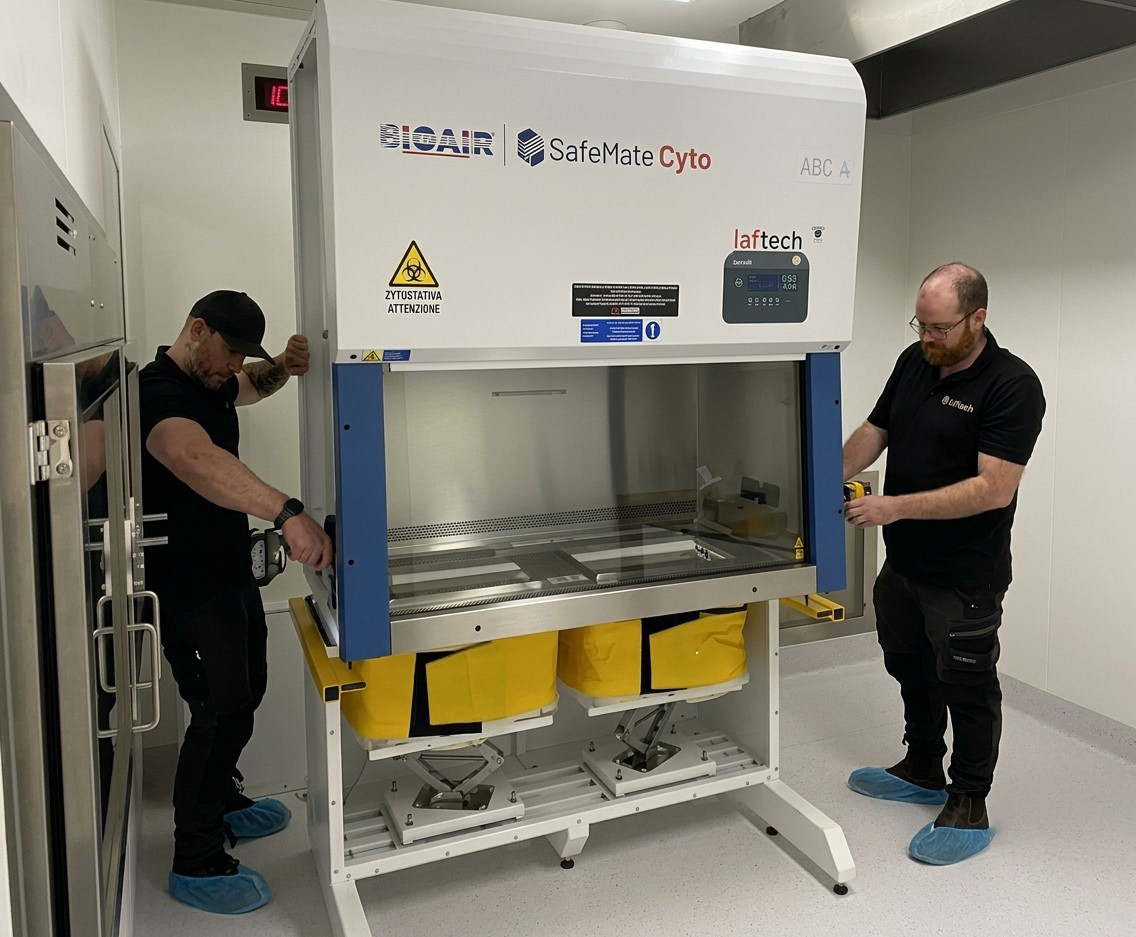
Cabinet design and configuration can materially affect the work involved. The contamination history matters too. If technicians need to access areas exposed to biological material, decontamination may be required before the filter can be safely removed.
Downtime should also be considered. A cabinet that cannot return to service until replacement, testing and certification are complete has an operational cost, particularly in laboratories with limited backup capacity.
For that reason, there is no standard cost that applies to every cabinet. The price of replacement depends on the work required to remove the existing filter safely, install the new one and return the cabinet to service with the necessary testing and certification completed.
Testing Before Replacing Can Save Money
There are two expensive approaches to filter maintenance. One is replacing a serviceable filter simply because it has reached a certain age. The other is leaving a deteriorating cabinet in service until a performance problem becomes unavoidable.
For a broader look at testing intervals, certification requirements and cabinet selection, see our complete guide to biological safety cabinet testing, certification and selection in Australia.
Regular testing offers a more defensible middle ground. We recommend reassessing cabinet performance after HEPA filter replacement, relocation or major service, alongside routine certification requirements.
For laboratories seeking biological safety cabinet testing Australia-wide, our NATA-accredited team can assess HEPA integrity, airflow and cabinet performance before recommending the next step. We provide testing, repairs, decontamination and HEPA filter replacement Australia-wide for most major biological safety cabinet brands.
If you are unsure whether a filter is genuinely at the end of its service life, contact LAF tech to arrange an assessment. Our team can determine whether replacement is necessary based on the cabinet’s condition, test results and overall performance.