








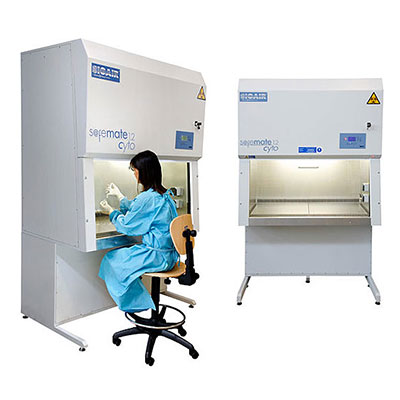






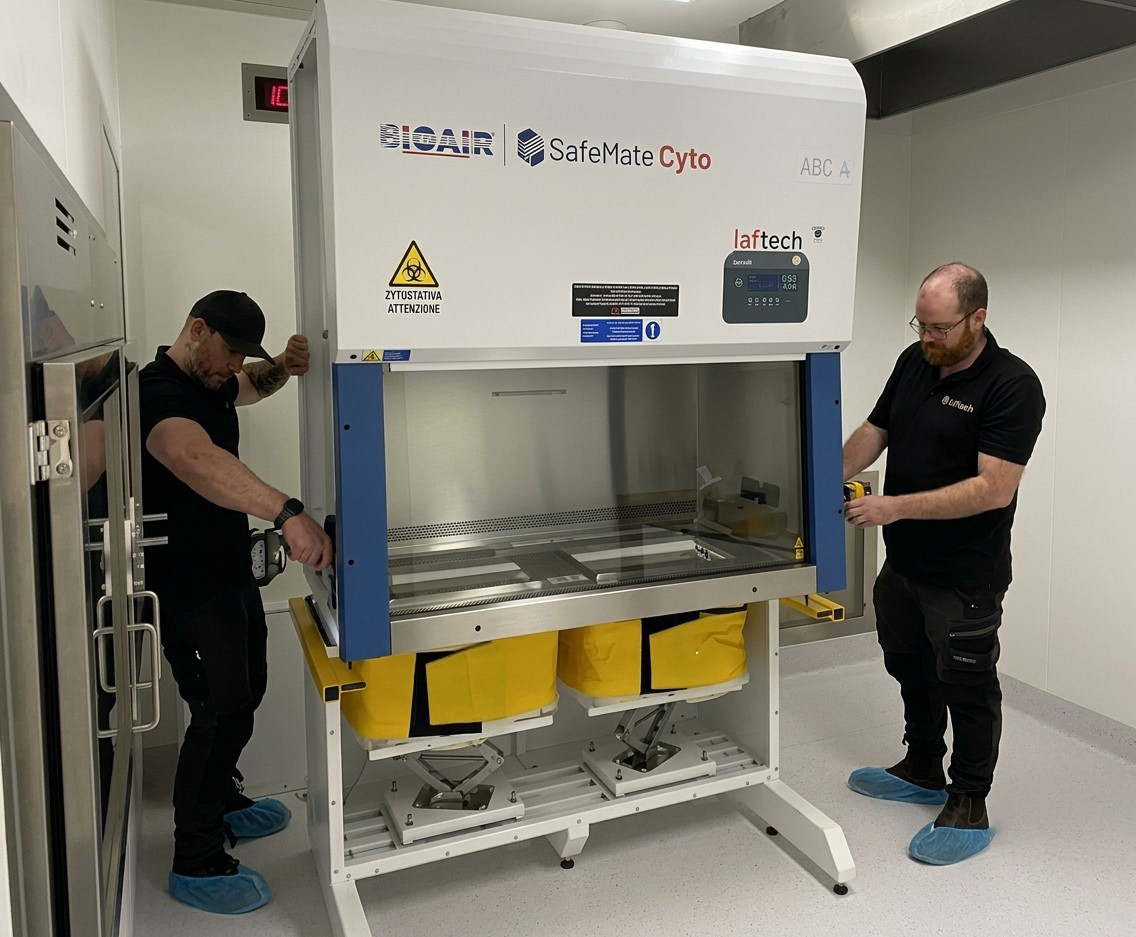
Moving a biological safety cabinet is not the same as relocating ordinary laboratory furniture. A BSC relies on controlled airflow, HEPA filtration, cabinet integrity and correct room placement to provide its intended level of protection.
- Before relocation, the cabinet’s use history and contamination risk must be reviewed, the work area cleared and the required decontamination method confirmed.
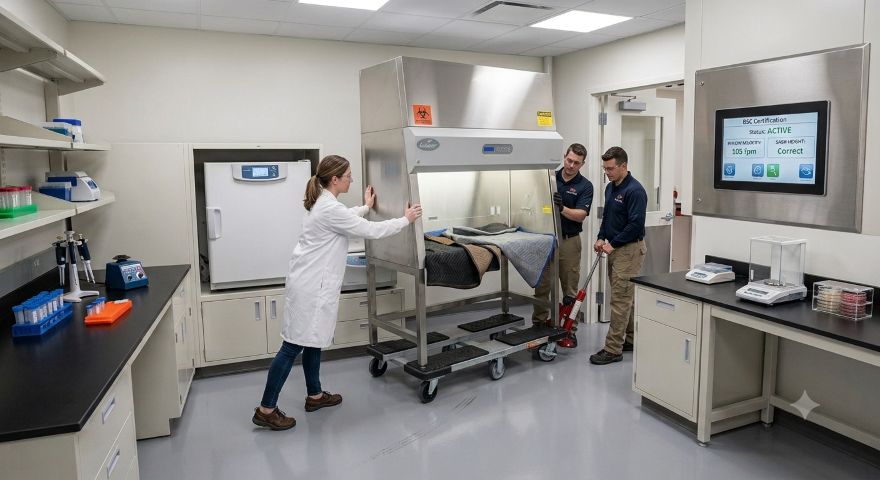
- During the move, the cabinet must be isolated, protected and handled by personnel who understand sensitive containment equipment.
- After installation, it should remain out of service until testing has confirmed that it is operating correctly.
The move is not complete when the cabinet reaches the new room. It is complete when containment performance has been verified and documented.
Why BSC relocation needs a controlled process
Biological safety cabinets protect personnel, products and, depending on the cabinet class and configuration, the surrounding environment. This protection depends on airflow patterns that can be affected by movement, vibration, cabinet levelling, service disconnection or an unsuitable new location.
A cabinet can appear undamaged and still have a compromised filter seal, airflow imbalance or alarm issue. The destination room may also introduce cross-draughts from doors, supply-air diffusers, fans or busy walkways.
For more details on cabinet classes, testing requirements and selection factors, read this complete guide to biological safety cabinet testing, certification and selection in Australia.
1. Before the move: Understand and control the risk
A useful relocation plan starts with the cabinet’s history, not the moving date.
Record the cabinet class, model, serial number, current room and intended destination. Review the agents, clinical materials, chemicals, toxins or radionuclides previously handled inside it. Recent spills, unusual residues, filter alarms, and repairs should also be documented.
Complete the following steps before movers take control:
- Remove cultures, samples, reagents, sharps, waste and loose equipment.
- Clean accessible surfaces according to the facility SOP.
- Confirm whether surface cleaning is sufficient or whether validated gaseous decontamination is required.
- Label the cabinet clearly as awaiting decontamination, decontaminated or out of service.
- Arrange authorised isolation of power, gas, vacuum and exhaust connections.
- Prepare a decontamination or safe-release record for the relocation team.
The required process should be based on the cabinet’s use, contamination history, and the work involved. A routine surface wipe should not automatically be treated as full decontamination, particularly if filters, contaminated plenums or internal components may be accessed.
This guide to preparing a biological safety cabinet for decontamination before service explains how to assess the cabinet, clear the work zone and document its status.
Where a validated process is required, LAF tech provides biological safety cabinet decontamination before relocation as part of its wider equipment and facility bio-decontamination capabilities.
Check the destination before transport begins
The new room should be assessed before the cabinet leaves its current position.
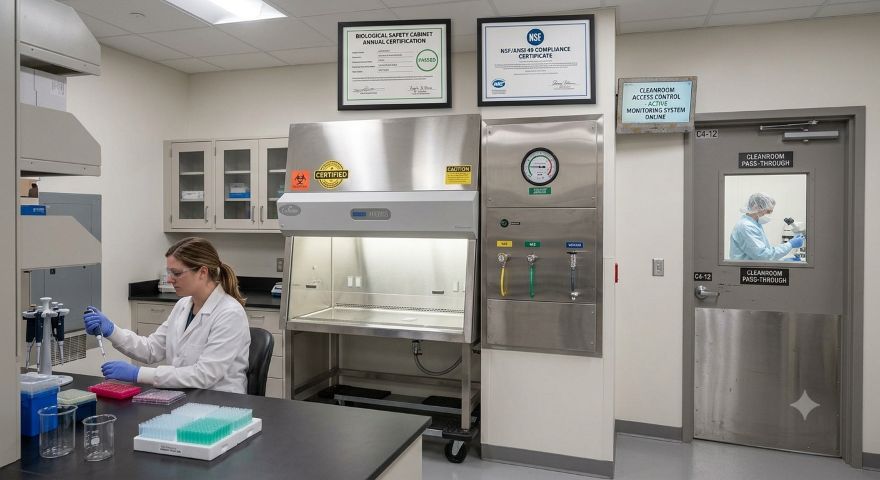
Confirm doorway, corridor and lift clearances, floor loading, electrical requirements and access for installation equipment. The final position must allow room for testing, maintenance and future filter access.
The cabinet should not be placed where doors, pedestrian traffic, fans or ventilation outlets can interfere with the front air barrier. Hard-ducted cabinets also require early coordination with qualified mechanical and building-services personnel.
The applicable cabinet standard, manufacturer instructions and facility risk assessment should guide the installation. Safe Work Australia also emphasises identifying biological hazards, assessing exposure risks, and reviewing controls when workplace conditions change.
2. During the move: Protect the cabinet and the people
Use personnel experienced in transporting scientific or containment equipment.
The cabinet should be moved in accordance with the manufacturer’s lifting instructions. Do not lift it by the sash, work tray, service fixtures or other unsupported components.
During transport:
- Secure the sash, removable trays and access panels.
- Keep the cabinet upright unless another orientation is authorised.
- Protect it from impact, moisture and excessive vibration.
- Maintain clear custody and condition records.
- Record any drop, collision or visible damage.
- Keep exhaust modifications and service reconnection under qualified control.
HEPA filters and their seals may be affected by shock without obvious external damage. Any transport incident should be disclosed to the testing technician before recommissioning.
3. After the move: Install, test and release
Once positioned, the cabinet should remain labelled out of service.
The installation team should level the cabinet, reconnect approved services, and inspect the sash, controls, seals, alarms, and exhaust connections. The new location should also be checked for airflow disturbances.
The cabinet must then undergo appropriate on-site performance testing. Depending on the cabinet and applicable requirements, this may include:
- Inflow and downflow velocity testing
- Airflow visualisation or smoke-pattern testing
- HEPA filter installation-integrity testing
- Air-barrier or containment testing
- Alarm and control verification
- Electrical and cabinet-specific safety checks
Any failed test must be investigated and corrected before the cabinet returns to biological work.
LAF tech provides BSC recertification after relocation. After successful testing, retain the report, certification label, next-due date and any corrective-action records. Update the equipment register, room records, SOPs and risk assessment before formally releasing the cabinet.
BSC relocation checklist
| Stage | Critical requirement |
| Before | Review use history, remove contents and confirm decontamination status |
| Destination | Check services, access, ventilation and cabinet position |
| During | Protect against shock, vibration, moisture and unauthorised modification |
| After | Install correctly and complete biological safety cabinet relocation testing in Australia |
| Release | Approve the cabinet before biological work recommences |
Frequently Asked Questions
Does a biological safety cabinet need certification after being moved?
A relocated BSC should be tested before returning to service. Movement can affect airflow, filter seals, cabinet levelling and containment performance even when no damage is visible.Does every BSC need gaseous decontamination before relocation?
No single method applies to every cabinet. The decision depends on previous use, contamination history, the planned work, facility procedures and whether internal contaminated areas will be accessed.Can a general removalist move a biological safety cabinet?
A removalist may handle the physical transport where appropriately equipped and briefed, but qualified personnel may still be required for risk assessment, decontamination, service isolation, exhaust work, installation and recertification.Plan the complete relocation, not only the transport
A successful BSC move ends with verified containment, not delivery. Early coordination between laboratory, biosafety, facilities, relocation and testing teams helps protect personnel, reduce downtime, and avoid expensive corrective work.
Contact the technical team at LAF tech to discuss decontamination, relocation planning and post-move BSC testing.