














Biological safety cabinets are one of the most misunderstood pieces of equipment in Australian labs. Labs buy the wrong class for the work. Facilities forget to re-certify after relocating one. Cabinets get “serviced” by providers who aren’t NATA-accredited, and the paperwork doesn’t surface the gap until an auditor finds it. What follows is what a lab should know before buying a cabinet, installing one, or signing off on its annual certification.
What a Biological Safety Cabinet Actually Does
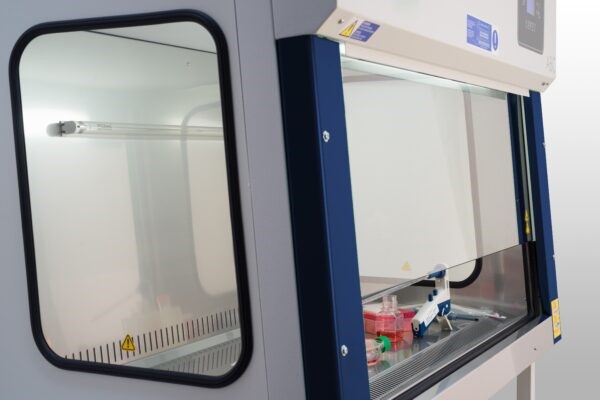
A biological safety cabinet is ventilated equipment that protects three things, in order of priority: the person working at it, the surrounding environment, and (depending on class) the work itself.
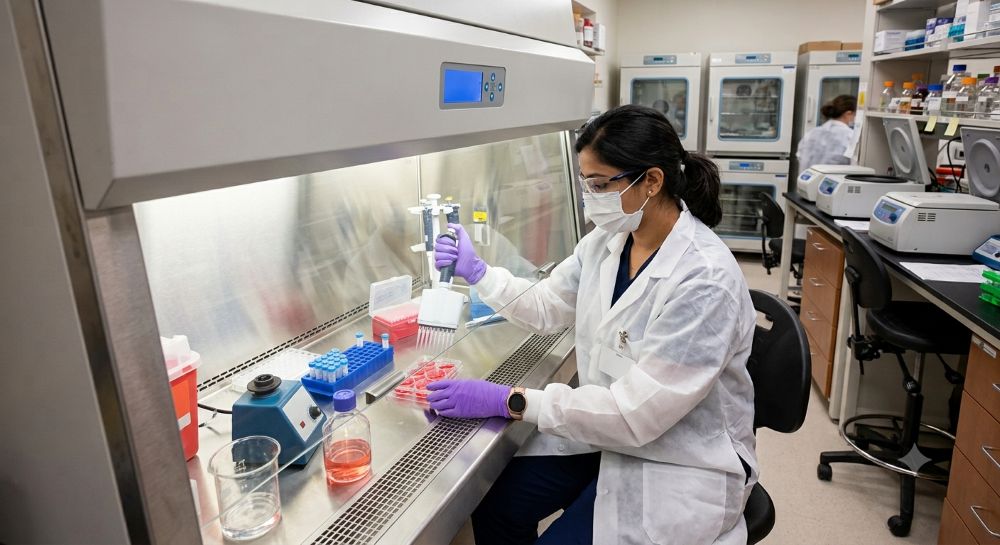
It does this through HEPA filters, negative-pressure plenums, and a downward curtain of filtered air that flows across the work zone. HEPA filters trap 99.97% of particles at 0.3 microns, which is the hardest size to capture; particles larger and smaller than 0.3 microns are actually captured at higher rates. In practice that means the filters hold on to bacteria, fungal spores, and virus-laden droplet nuclei. Aerosols generated during pipetting, centrifugation, or vortexing are pulled away from the operator’s face and captured before they can escape the cabinet.
The air curtain at the sash opening is the other half of the story. On a Class II cabinet, room air is drawn in at roughly 0.80 metres per second, forming an invisible barrier that stops contaminants inside the cabinet from drifting out and stops room contaminants from drifting in. Disrupt that curtain (fast hand movements, a nearby door, an air conditioning draught) and containment degrades immediately. This is why installation location matters almost as much as the cabinet itself.
What a BSC doesn’t do matters just as much. It isn’t a fume cupboard. It doesn’t protect against volatile chemicals or heavy vapour loads, and its HEPA filters aren’t designed to handle solvents or acids. Using the wrong cabinet for the wrong hazard is one of the most common and dangerous mistakes in Australian labs. A BSC and a fume cabinet are engineered for opposite problems, and no amount of careful technique will make one do the other’s job.
The Australian Standards That Actually Matter
BSCs in Australia sit under a stack of standards, and you need to know which applies to what.
AS 1807 sets out the test methods used for biological safety cabinets, laminar flow cabinets, and clean workstations. This is the document a NATA-accredited technician works from when certifying performance.
AS 2252 covers construction and performance. AS 2252.2 applies to Class II cabinets; AS 2252.4 applies to Class I. If a cabinet wasn’t built to these standards, it will struggle to pass testing to AS 1807 at installation.
AS/NZS 2243.3 is the safety in laboratories standard that defines Physical Containment (PC) levels 1 through 4 and links them to required cabinet classes. It’s the standard that tells you which cabinet belongs in which lab.
NSF/ANSI 49 is a US standard sometimes referenced by imported cabinets. Australian buyers should confirm the cabinet also meets the AS requirements, because that’s what it will be tested against on Australian soil. If a supplier hands you a cabinet certified only to NSF/ANSI 49, ask how they plan to pass the first site test.
Class I, Class II, Class III: Picking the Right Cabinet
Cabinet class is not a marketing term. It’s a protection profile, and each class exists for a specific reason.
Class I cabinets protect the operator and the environment but not the work. Air flows inwards at the sash opening, past the sample, and then through a HEPA filter before discharge. Nothing filters the air that reaches the sample, so Class I is only appropriate when contamination of the work doesn’t matter, for example, routine animal cage changes or certain waste handling tasks.
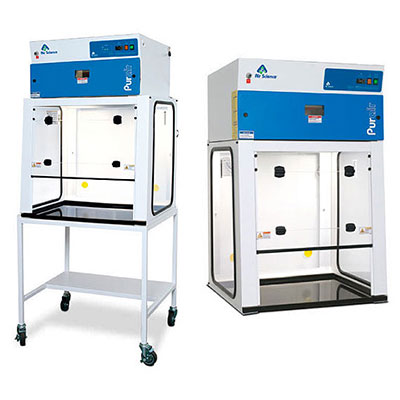
Class II cabinets protect the operator, environment, and product. These are the ones you see most often in hospital pathology, microbiology, and cell culture. Class II splits further by airflow configuration and exhaust arrangement:
- Class II A2 recirculates around 70% of the air and exhausts 30%, usually back into the room or through a thimble duct. Suitable for low-to-moderate risk microbiology. Not appropriate for volatile toxic chemicals.
- Class II B1 runs 70% exhaust, 30% recirculation, and is hard-ducted to outside. Safer for small amounts of volatile or toxic chemicals used alongside biological agents.
- Class II B2 runs 100% exhaust, no recirculation, and is hard-ducted. Used where volatile toxic chemicals or radionuclides are handled alongside biological work.
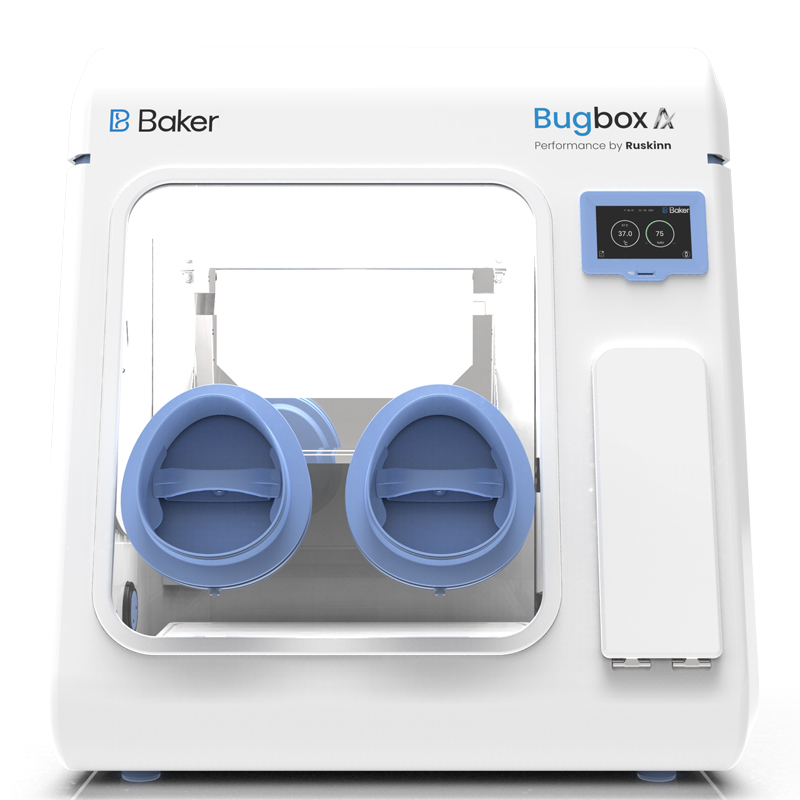
Class III is a fully enclosed, gas-tight glove box operated under negative pressure. Work passes in and out through a dunk tank or double-door autoclave. Class III is used for PC4 pathogens and nothing less.
The PC level to cabinet class mapping. Under AS/NZS 2243.3, PC1 work (low-risk organisms, non-pathogenic strains) often doesn’t require a BSC at all, though one is frequently used anyway for aseptic protection. PC2 work (most clinical pathology, routine human and animal cell culture, most bacterial and viral work with known low to moderate risk agents) runs in a Class II BSC. PC3 work (TB culture, certain zoonotic agents, unidentified clinical isolates of concern) requires a Class II cabinet inside a PC3 facility with additional engineering controls, or a Class III cabinet. PC4 work is Class III only, inside a purpose-built PC4 facility. Getting the mapping wrong exposes staff, compromises work, and can trigger an institutional biosafety committee review before the auditor even arrives.
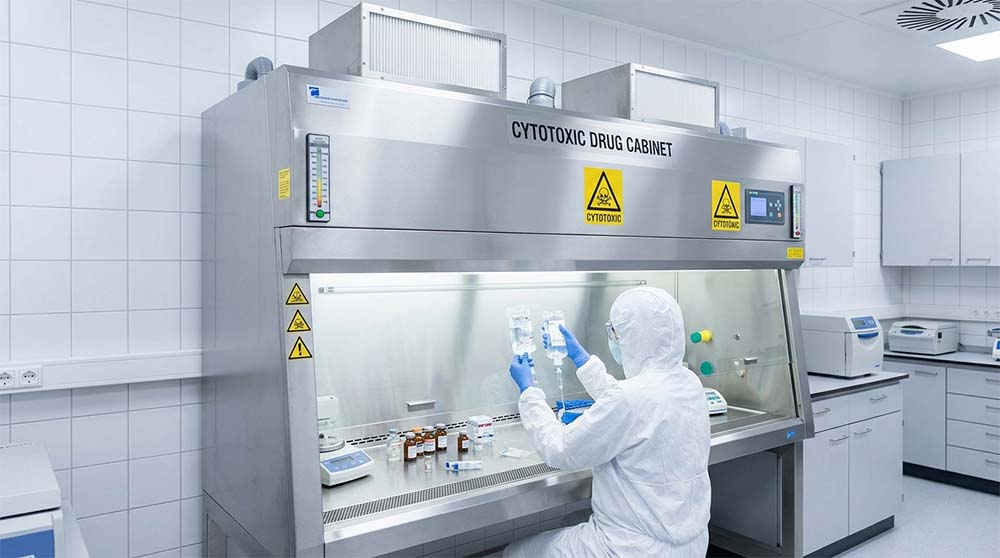
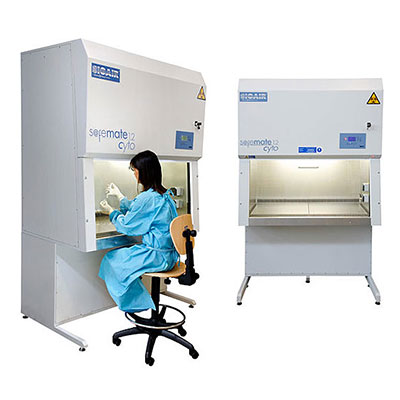
The mismatch that costs labs the most money: running cytotoxic drug work in a Class II A2. A Class II A2 protects against aerosols but isn’t validated for cytotoxic compounding. That’s why cytotoxic cabinets exist as a separate category, engineered and certified under AS 2639 rather than AS 2252 alone.
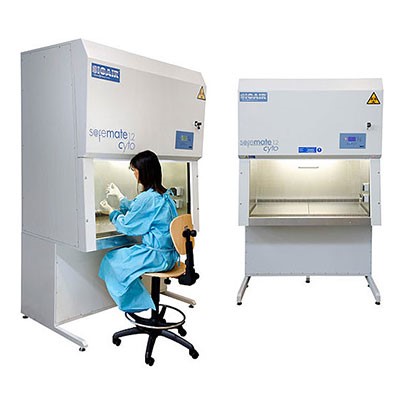
(cytotoxin cabinet)
BSC vs Cytotoxic Cabinet vs Laminar Flow vs Fume Cabinet
This is where buyers lose money. Four pieces of equipment look superficially similar and do fundamentally different things.
| Equipment | Protects Operator | Protects Product | Protects Environment | Typical Use |
| BSC Class II | Yes | Yes | Yes | Microbiology, cell culture, PC1 to PC3 |
| Cytotoxic cabinet | Yes | Yes | Yes | Hazardous drug compounding under AS 2639 |
| Laminar flow cabinet | No | Yes | No | Sterile product preparation where the sample must stay clean |
| Fume cabinet | Yes | No | Yes | Volatile chemicals, solvents, acid work |
A laminar flow cabinet blows filtered air outwards, toward the operator. Using one to handle pathogens puts the person at the cabinet directly in the path of any aerosol generated. Using a BSC to handle solvents overloads HEPA filters that weren’t built for chemical vapour. The two are not interchangeable, no matter how similar the front panel looks.
Where You Put the Cabinet Matters
A cabinet that passes factory testing can fail site certification for reasons that have nothing to do with the cabinet itself. Installation location is the quiet killer of BSC performance.
The air curtain at the sash relies on a stable room environment. Locate a Class II cabinet directly opposite a frequently used door, and every door swing disrupts the inflow. Position it under a ceiling diffuser or next to a return air grille, and the downflow fights with room air currents. Put it in a narrow space where two technicians have to pass behind each other, and routine traffic will pull contaminants out of the cabinet at the moment someone’s elbow-deep in a culture flask.
Before installation, confirm the room has enough clearance behind the cabinet for service access (typically 300mm minimum), that adjacent equipment doesn’t generate heat plumes or vibration (centrifuges, autoclaves, fridges with hard-working compressors), and that the floor is level to within the manufacturer’s tolerance. For B1 and B2 cabinets, the duct run and the exhaust fan need to be sized to match the cabinet’s requirements; an undersized fan won’t maintain the airflows the test procedure demands.
A site visit before purchase saves a retrofit after delivery. It’s cheaper than any of the alternatives.
What NATA-Accredited Testing Actually Covers
Annual certification isn’t one test. It’s a sequence of checks, each measuring a specific aspect of the cabinet’s containment profile.
HEPA filter integrity is scanned across the filter face with a photometer while the filter is challenged with an aerosol. If the filter has a pinhole leak, this finds it.
Downflow velocity is measured across the work zone to confirm the vertical airflow speed matches manufacturer specification and the standard. Inflow velocity is measured at the sash to confirm operator protection is intact.
Airflow pattern testing releases a visible tracer so the technician can confirm air moves in the right direction at every point inside the cabinet, including around the sash opening. Sash height alarms and interlock checks confirm the cabinet warns the operator the moment the sash rises above the safe operating height.
Site installation testing checks that the cabinet hasn’t been positioned somewhere that disrupts its own airflow: near a door, under a ceiling vent, in a cross-draught from an air conditioning outlet.
NATA accreditation means the testing organisation has been independently assessed for technical competence, has documented procedures, uses traceable instruments, and is subject to surveillance audits by NATA itself. A non-accredited provider might perform the same tests, but the certificate they produce won’t hold up under TGA or pathology accreditation audit. NATA-accredited testing is not a nice-to-have for regulated labs; it’s the floor.
The Certification Schedule: When to Test
Annual certification is the baseline, not the ceiling. A BSC needs to be tested whenever any of the following happen.
- Annually, as required under AS 1807 and institutional biosafety policy.
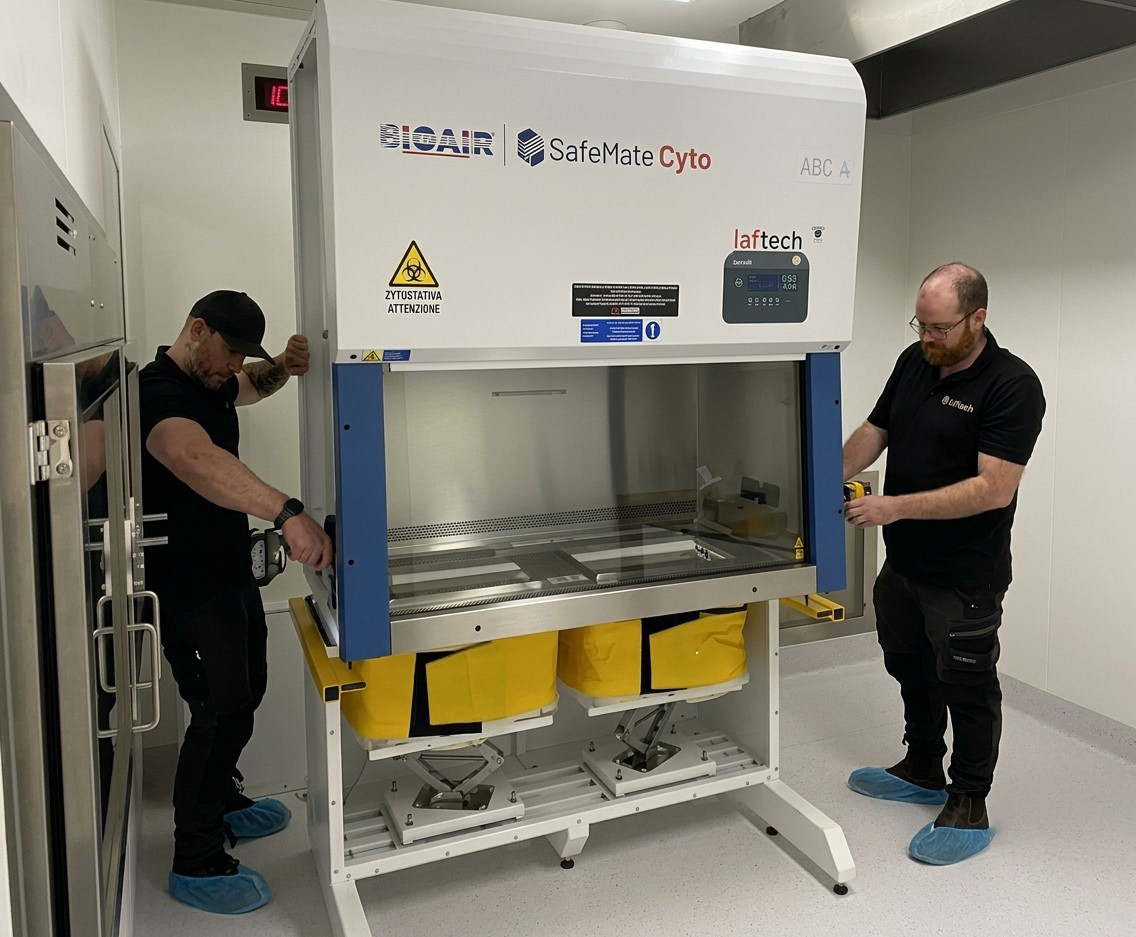
- After relocation, because even a three-metre move can disrupt airflow and invalidate the previous test.
- After HEPA filter replacement, because integrity and velocity must be re-established for the new filter.
- After major service or repair, particularly anything that affects the blower, the plenum, or the sash.
- After a containment failure or spill, including after any bio-decontamination cycle.
A cabinet that’s overdue for certification shouldn’t be used for containment work. Labs sometimes keep using one “just for another week” while waiting for a technician. That’s the week the auditor shows up.
Planning to move a cabinet? Follow our BSC relocation checklist to understand the decontamination, transport, installation and recertification steps required before, during and after the move.
What a Valid Certificate Looks Like
A compliant certificate includes the NATA endorsement mark and accreditation number, identifies the specific standard tested to (AS 1807), lists every test performed with measured values and pass or fail outcomes, names the technician and the equipment used, and includes the next-due date. If any of these are missing, the document is paperwork rather than a certificate. A quick way to audit your own records: pull three certificates at random from the last twelve months and check each against that list. Gaps usually mean the service wasn’t accredited, wasn’t complete, or both.
Consequences of Running Out-of-Certification Cabinets
The stakes aren’t theoretical. Australian labs operating under TGA licences, NATA accreditation, NPAAC standards, or hospital accreditation schemes face findings for gaps in BSC certification. Findings can escalate to suspension of testing scope, which means samples get routed to competitors while the lab scrambles to remediate.
For pathology labs, RCPA and NPAAC both require documented evidence that containment equipment is fit for purpose. For pharmaceutical manufacturers, a lapsed certificate during a TGA inspection becomes a GMP deviation that has to be investigated and reported. For university research groups, institutional biosafety committees can suspend a project until testing is restored.
Insurance is the other piece. A workplace exposure incident traced to an out-of-certification cabinet changes the liability conversation in ways nobody wants to discover after the fact.
Maintenance Beyond the Annual Test
Certification is a snapshot. Between tests, a cabinet needs ongoing care that annual testing won’t catch.
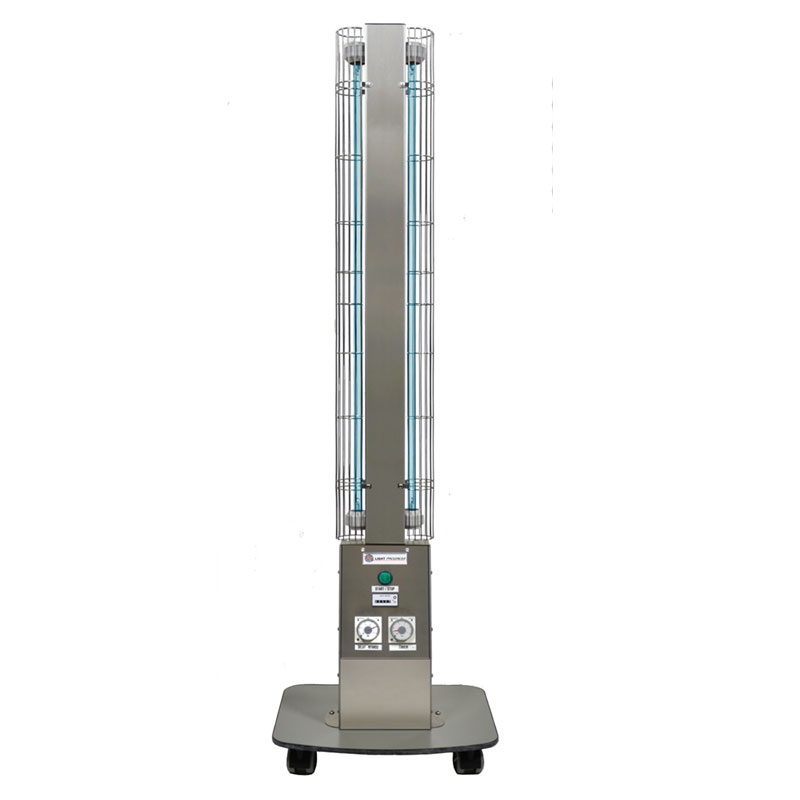
Germicidal UV lamps lose output well before they burn out. Replace them every twelve months of active use, even if they still glow. Test them with a UV dosimeter if you want proof.
Internal surfaces need daily wipe-down with an appropriate disinfectant. “Appropriate” matters here. A random alcohol spray won’t kill non-enveloped viruses or bacterial spores. Match the disinfectant to the organisms the cabinet is actually used for.
Some cabinets have a pre-filter that clogs faster than the main HEPA. Ignoring it shortens the life of the primary filter and can alter airflow velocities enough to fail the next certification. Pre-filter inspection belongs on the monthly calendar.
Before any internal service on a potentially contaminated plenum, the cabinet needs a validated bio-decontamination cycle. Vaporised hydrogen peroxide is the common method; formaldehyde is still used in some facilities. Whichever method applies, a technician shouldn’t be opening a contaminated cabinet, and a lab manager shouldn’t be asking them to.
For practical pre-service steps, read our guide on preparing a biological safety cabinet for decontamination before service before arranging filter access, airflow testing, sash adjustment, repairs or internal inspection.
Alarms and sash interlocks need periodic functional testing. A silent alarm is worse than no alarm, because everyone assumes it works. Build a monthly functional check into the lab’s equipment log: raise the sash beyond the safe height and confirm the audible and visual alarms trip within a few seconds. Write the result down. The auditor will want to see the record, not just hear you describe the process.
Selecting a Supplier: What Matters More Than the Brand
Brand matters, but only up to a point. Cabinets from reputable manufacturers all build units that will pass certification when installed and operated correctly. Where labs actually lose money is in the service relationship.
Three questions to ask before signing a purchase order.
Is the supplier NATA-accredited for site testing, or do they subcontract to a third party? Every handover adds scheduling risk and complicates the paperwork trail during audit.
What’s their national service coverage? A cabinet in Perth that has to wait six weeks for a Melbourne-based technician is effectively out of service. Ask for actual response times, not marketing response times.
Do they offer calibration services for adjacent lab equipment such as incubators, freezers, and centrifuges? A single-vendor calibration relationship is simpler, cheaper, and easier to defend at audit than juggling four different service providers with four different scheduling systems.
The lab that pays the most for BSCs over their lifecycle isn’t the one that buys the most expensive cabinet. It’s the one that buys a cheap cabinet from a supplier that can’t service it.
All in all, pick the cabinet class that matches the work, not the other way round. Buy from a supplier whose service team you’d want to deal with at 4pm on a Friday. Certify annually, re-certify after any move or filter change, and keep the certificates somewhere you can find them in under a minute. That’s 90% of staying compliant.
LAF tech has been supplying and servicing biological safety cabinets, cytotoxic cabinets, and laminar flow systems across Australia since 1987. Our national field service team holds NATA accreditation for on-site BSC testing to AS 1807, and we service what we sell. To schedule certification, replace a failing cabinet, or book a technician, get in touch on 1300 306 002 or through the contact page.