














A $100,000 research project can unravel for reasons that never show up in the method section. A reagent lot changes, a freezer warms during a storm, or a sensor drifts just enough to push conditions off target. The most expensive version of this is subtle: a 0.1°C offset that sits quietly inside “normal” readings until results stop lining up. This is where NATA-accredited calibration earns its keep for labs across Australia.
Why 0.1°C matters in modern research labs
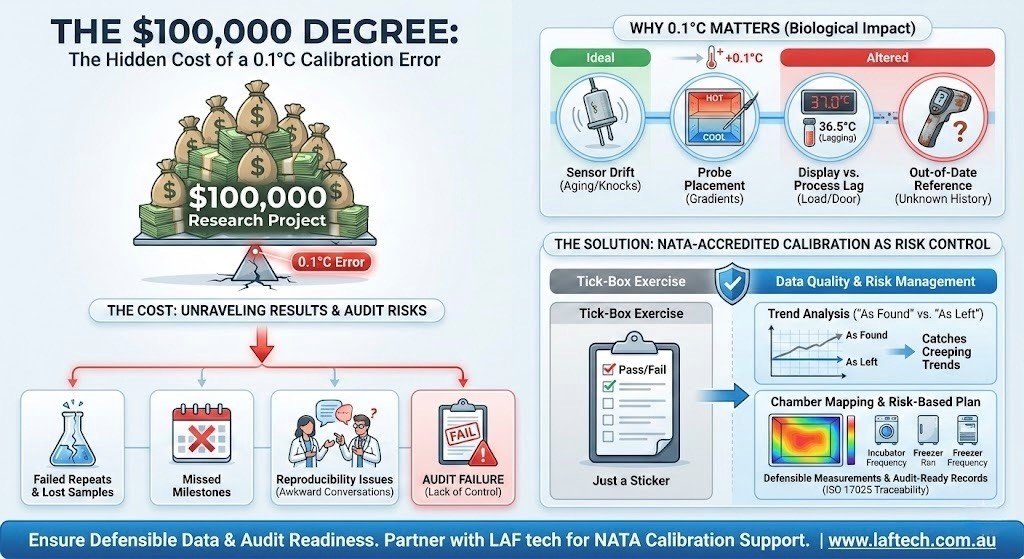
Temperature affects reaction rates, solubility, viscosity, microbial growth, enzyme activity and cell behaviour. Many biological systems run in narrow operating bands, and even small departures can change outcomes when you repeat a protocol over days or weeks.
Incubation is a good example:
- CO₂ incubators are commonly set around 37°C with relatively tight tolerances, and maintaining a stable, uniform environment is part of keeping cultures consistent.
- In embryo culture, minor temperature variations around 0.5°C can alter developmental outcomes.
While 0.1°C sounds smaller than that, it rarely arrives alone. A small sensor offset often combines with gradients (top shelf vs bottom shelf), door openings, and recovery time, so the true conditions experienced by samples can drift further than a single number suggests.
The cost lands in repeats, lost samples, missed milestones, and awkward conversations when collaborators cannot reproduce your findings.
Common sources of calibration error:
Most temperature problems are not dramatic failures. They are slow, ordinary changes that compound.
- Drift over time: Sensors and electronics shift as they age, get knocked, or run near their limits.
- Probe placement: A chamber can read correctly at the sensor location while other zones run hotter or cooler. Airflow, shelf loading, and where a probe is taped down all matter.
- Mismatch between “display” and “process”: The controller may be stable, but the sample temperature lags, especially with dense loads or frequent door openings.
- Out-of-date references: A working thermometer used to “check the incubator” is only as good as its own calibration history.
- Misread paperwork: “As found” results show what the instrument was doing when it arrived. “As left” shows what changed after adjustment. If you only look at the final line, you may miss a creeping trend.
This is also where temperature calibration stops being a tick-box exercise and becomes a risk control. If the temperature is a critical method parameter, you want evidence that the measuring chain is sound, not just a sticker.
0.1°C calibration error impact on research results
A 0.1°C error can cause damage in two ways.
- First, it can push a system outside the limits your method quietly assumes. Many methods don’t state temperature sensitivity in bold letters. They state incubation time, reagent volumes, mixing steps, and call it done. Yet temperature sits behind those steps like a silent setting on the whole workflow.
- Second, it can break comparability. If Lab A runs at a true 37.0°C and Lab B runs at a true 36.9°C, both may appear compliant, yet results can drift apart. Over multiple passages, cycles, or batches, those small differences can show up as “noise” that you cannot explain, then as a result that refuses to replicate.
This is why serious labs treat calibration as part of data quality.
What auditors and reviewers tend to look for in calibration records
Most audits don’t fail because someone forgot to calibrate one item. They fail because the lab cannot show control.
A solid NATA calibration certificate (or an equivalent accredited certificate) usually needs to be readable by someone outside your team:
- Clear identification of the instrument
- Dates
- Environmental conditions
- Results
- Stated uncertainty, and
- Traceability
If your lab is audited, the assessor may also compare your decisions to the evidence: did you review “as found” data, respond to drift, and record corrective actions? That’s where ISO 17025 traceability and good record-keeping really matter.
A lab-ready checklist to stop calibration drift from becoming a write-off
If you only do one thing, make calibration risk-based. Not everything needs the same frequency or the same level of rigour.
- Maintain a register of critical instruments (incubators, stability chambers, fridges/freezers, data loggers, reference thermometers).
- Review “as found” results, not just the pass/fail line. Trend drift over time.
- Map chamber gradients when the load changes, shelving is rearranged, or methods become tighter.
- Control probe placement and logging intervals. “Random spot checks” rarely catch the real problem.
- Align acceptance criteria to method needs, not generic tolerances.
- Store certificates where staff can actually find them during an audit.
When you bring in external instrument calibration services, such as LAF tech, ask whether they can support on-site work, documentation review, and advice on interval setting. For multi-site teams in Melbourne and Sydney, consistent practice matters as much as the calibration itself.
LAF tech – Calibration support across Australia and New Zealand
If your results depend on controlled environments, calibration should sit alongside maintenance and verification, not behind them.
At LAF tech, services are designed to support laboratories that need defensible measurements, audit-ready records, and practical guidance that fits day-to-day work. Book our NATA calibration services in Australia to get started.
Frequently Asked Questions:
1) How can a 0.1°C calibration error affect reproducibility?
Reproducibility relies on comparable conditions across runs, operators and sites. A small offset can shift growth rates, reaction kinetics or stability behaviour, particularly over long incubations. The bigger issue is that the offset often combines with chamber gradients and recovery times, so samples experience a larger variation than the display suggests.
2) What should a calibration certificate include for research and audit purposes?
Look for clear instrument identification, calibration date, environmental conditions, results (including “as found” where provided), the stated uncertainty, and traceability information. Accreditation adds confidence because an independent body has assessed the lab’s competence and systems against a recognised standard.
3) What is the difference between accredited and traceable calibration?
Traceable calibration links measurements back to recognised standards through a documented chain. Accreditation adds independent assessment of competence and impartiality against a standard such as ISO/IEC 17025. That extra layer is often expected when decisions have higher stakes.
4) How often should thermometers, probes and data loggers be calibrated?
There is no universal interval. Set it based on risk: how sensitive your method is to temperature, how stable the device has been historically, how often it is used, and the consequences of error. Review drift trends from past certificates and shorten the interval for instruments that show movement.
5) What are practical signs an instrument is drifting out of tolerance?
Watch for slow changes that staff normalise: longer warm-up and recovery, results that trend over time, mismatch between an internal display and an independent check, and increased variability between shelves or zones. If you rely on a chamber for critical work, treat unexplained variability as a measurement problem until you can rule it out.